
The aim and approach of EMO-GI
EMO-GI—Socio-Emotional Learning on Climate Change Mitigation via Geoinformation and AI—aims to help teachers connect climate knowledge, emotional awareness and meaningful action. The project brings together social-emotional learning, geoinformation and artificial intelligence to strengthen climate change education in primary and secondary schools through teacher education.
Why the project is needed
Climate change affects how young people understand their future and how they feel about it. Learning about environmental threats can generate worry, sadness, anger or helplessness, alongside hope, curiosity and determination. These responses influence learners’ engagement with climate information and their confidence in contributing to change.
The literature reviewed for EMO-GI highlights two connected challenges: climate education needs to acknowledge these emotional experiences, and greater knowledge does not automatically lead to effective action. Teachers therefore need support to address scientific evidence, emotional responses and practical mitigation options together.
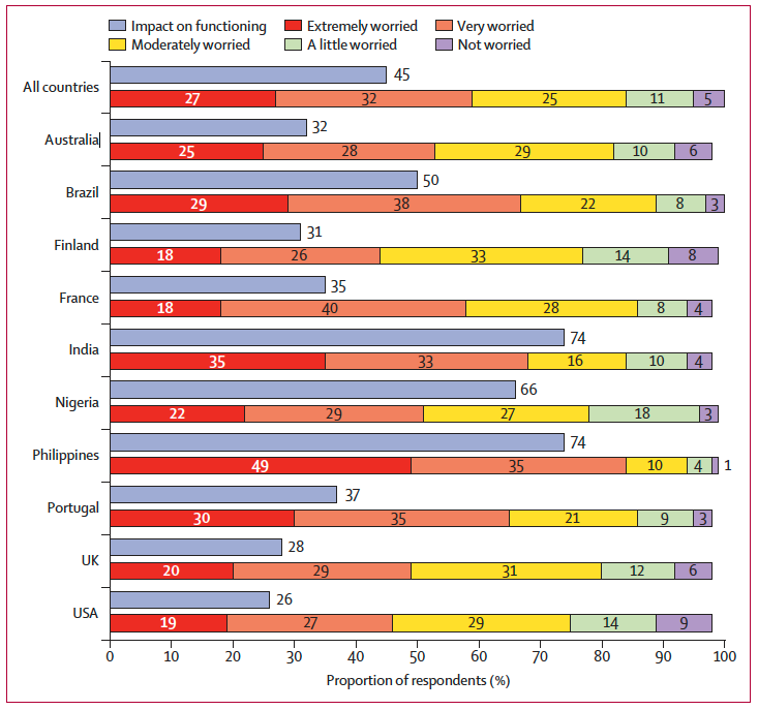
Worry about climate change and reported impact on daily functioning. Reproduced from Figure 1 of the EMO-GI report, citing Hickman et al. (2021). The study included 10,000 young people across ten countries, with 1,000 respondents per country. These are findings from that sample, rather than estimates for all young people worldwide.
Building on GI-Learner and GI-Pedagogy
EMO-GI continues the work of GI-Learner, which developed a progression for geospatial thinking, and GI-Pedagogy, which developed approaches and resources for effective teaching with geographical information systems.
These projects provide foundations for investigating places, interpreting spatial evidence and designing learning activities. EMO-GI extends this work by exploring how learners respond emotionally to climate evidence and how teachers can connect that evidence with reflection, dialogue and action. It also examines the educational possibilities and responsibilities associated with AI.
An approach grounded in research and experience
The project’s literature review assembled approximately 300 publications and selected 56 for detailed analysis. It examines emotional responses to climate change, teaching approaches for primary and secondary education, and knowledge of climate change mitigation. This research provides a basis for developing educational resources and teacher training.
The approach connects three dimensions of learning:
- Understanding: interpreting climate evidence, recognising misconceptions and assessing mitigation options.
- Emotional awareness: recognising feelings, listening to different experiences and discussing concerns without judgment.
- Action: making informed decisions, collaborating and exploring responses at personal, school, community and wider societal levels.
Geoinformation and geomedia can make these connections tangible. Maps, satellite images and local environmental data help learners investigate how climate change affects particular places and communities. Inquiry, outdoor learning and collaborative projects can connect these investigations with lived experience.

The Climate Emotions Wheel, reproduced from Figure 2 of the report. Credit: Climate Mental Health Network, © 2024, CC BY-NC-SA. The wheel supports reflection and discussion; it is not a diagnostic tool.
The report also explores frameworks such as CARE–KNOW–DO, which connects engagement, knowledge and practical application, and CLARITY, which addresses transformative climate resilience education. These offer reference points for EMO-GI’s developing framework. A central principle is to make room for difficult emotions while supporting realistic hope and a sense of agency.
AI forms another strand of the project. EMO-GI explores its use in accessing and discussing climate information, alongside guidance on responsible use. Critical assessment remains essential: teachers and learners need to question outputs, check sources and consider the environmental implications of the technologies they use.
What we want to achieve
We want to equip teachers with the knowledge, approaches and resources to address climate change confidently and sensitively. Planned outcomes include a social-emotional learning framework for teacher education, educational resources, guidance on responsible AI use and piloting in climate change mitigation initiatives.
For learners, the ambition is to develop scientific understanding, emotional literacy, critical thinking and confidence in participating. This includes recognising that climate action depends on collective decisions and supportive institutions, as well as individual choices. Children should have opportunities to contribute without being made to feel responsible for solving the crisis themselves.
Ultimately, EMO-GI seeks to support education in which learners can understand climate change, acknowledge their responses and work with others towards informed, constructive action.
